

What Is The Best Flooring for Schools?

Choosing flooring for a school sounds simple until you think about everything a school floor has to survive.
Hundreds or even thousands of students.
Backpacks dragged across hallways.
Wet shoes in the winter.
Rolling carts.
Tables and chairs.
Food spills.
Assemblies.
After-school programs.
Custodial equipment.
And then everyone comes back tomorrow and does it all over again.
For school districts, flooring isn’t just a design decision. It’s a long-term facility investment.
So what is the best flooring for a school?
The answer depends on where the floor is going and what that space needs to handle.
There Isn’t One Best Floor for an Entire School
One of the biggest mistakes in commercial flooring is trying to solve every space with the same product.
A classroom doesn’t experience the same traffic as a main entrance.
A cafeteria doesn’t have the same needs as an administrative office.
A corridor connecting hundreds of students to their classrooms every day has very different demands than a library.
The better question is:
What’s the best flooring for this particular area of the school?
That’s where the decision becomes much easier.
What Should Schools Look for in Flooring?
Before choosing a color or pattern, school districts and facility managers should consider how the floor will actually be used.
Durability
Schools are high-traffic environments.
Corridors, entrances, cafeterias, and common areas can experience enormous amounts of foot traffic throughout the year.
Flooring in these areas needs to be selected with that use in mind.
A product that performs perfectly in a lightly used office may not be the best choice for a busy school hallway.
Maintenance
Installation is only the beginning of a floor’s life.
Someone has to clean and maintain it for years afterward.
That makes maintenance requirements an important part of the purchasing decision.
School districts should consider not only what a flooring system costs to install, but also what will be required to keep it looking and performing properly.
Moisture
Snow.
Rain.
Spilled drinks.
Mop water.
Plumbing problems.
Moisture can show up in schools in plenty of ways.
Entrances, cafeterias, restrooms, locker areas, and other moisture-prone spaces may require very different flooring considerations from classrooms or administrative areas.
The substrate underneath the finished floor also matters.
Proper evaluation and preparation before installation can be just as important as the flooring selected for the surface.
Safety
Flooring decisions should also consider the way a space is used.
Slip resistance, transitions between flooring materials, surface condition, maintenance practices, and accessibility can all affect how a floor performs in a busy public facility.
The goal isn’t simply to install something that looks good.
It needs to work for the people using the building every day.
Appearance
Durability doesn’t mean a school has to look institutional.
Modern commercial flooring is available in an enormous range of colors, patterns, textures, and designs.
Flooring can complement school colors, help define different areas of a building, and contribute to the overall feel of the facility.
A school can have a floor that’s practical and looks good.
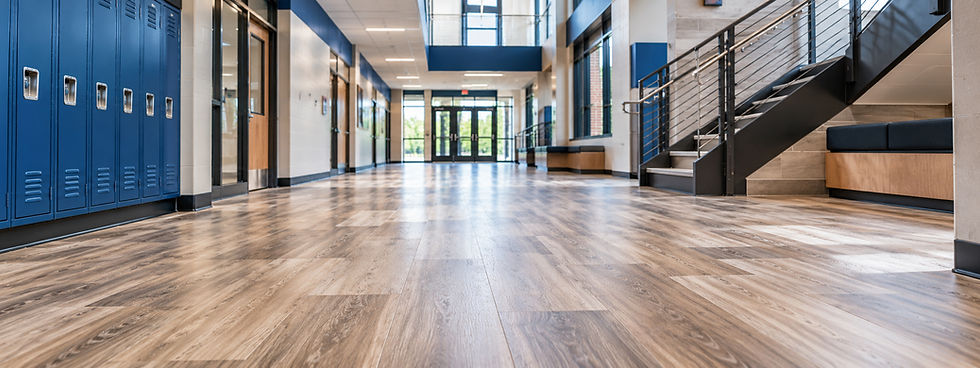
What Flooring Works Well in School Hallways?
Hallways are some of the hardest-working spaces in a school.
Students move through them repeatedly throughout the day, which means durability and maintainability become major priorities.
Commercial resilient flooring systems are often considered for these areas because they can provide a combination of durability, design flexibility, and practical maintenance.
The exact product should still be selected based on the facility’s needs, substrate, traffic, maintenance program, and project specifications.
What About Classrooms?
Classrooms create a different set of priorities.
The floor still needs to withstand daily use, but comfort, acoustics, maintenance, appearance, and the type of activities taking place in the room may also influence the decision.
An elementary classroom may have very different flooring needs from a science lab, art room, computer lab, or high school classroom.
Again, the room should help determine the floor.
Cafeterias Need Their Own Strategy
If there’s one place where flooring gets tested, it’s a school cafeteria.
Food.
Drinks.
Chairs.
Tables.
Constant movement.
Regular cleaning.
Cafeteria flooring should be selected with those realities in mind.
Durability, cleanability, moisture exposure, and appropriate slip resistance are all important considerations.
This is an area where choosing a floor based solely on appearance can become expensive later.
Don’t Forget Entrances
The entrance is where the outside world meets the inside floor.
Water, dirt, sand, snow, and other debris can all be tracked into the building.
That doesn’t just affect the entrance itself.
Debris can travel farther into the facility and contribute to wear on surrounding flooring.
A good flooring plan considers the entire entrance area and how the facility will manage what gets tracked inside.
What About Recreation Centers?
Many of the same principles apply to recreation centers.
But rec centers can be even more complicated because one building may contain:
Lobbies
Corridors
Offices
Community rooms
Fitness areas
Locker rooms
Restrooms
Multipurpose spaces
Athletic areas
Gymnasiums
Trying to choose one flooring material for all of those environments doesn’t make much sense.
Instead, the facility should be treated as a collection of spaces with different performance requirements.
Permanent Flooring Should Be a Long-Term Decision
When schools and recreation centers evaluate flooring, the initial installation price is only part of the equation.
There’s also maintenance.
Repair.
Expected service life.
Downtime.
Future replacement.
And the disruption that flooring work can cause in an occupied building.
A floor that looks inexpensive on bid day isn’t necessarily the least expensive floor over its entire service life.
That’s why flooring decisions should be made with the long term in mind.
Summer Isn’t the Only Time to Start Planning
Many school flooring projects are completed during summer breaks because buildings are less occupied.
But that doesn’t mean planning should begin in June.
Product selection, budgeting, specifications, scheduling, substrate evaluation, procurement, and coordination can all happen well before installation begins.
The earlier a district understands what it needs, the easier it can be to develop a realistic flooring plan.
So, What Is the Best Flooring for a School?
There isn’t one answer.
And that’s actually the answer.
The best flooring is the system that fits the space, traffic, maintenance requirements, substrate conditions, budget, and long-term goals of the facility.
A busy hallway may need one solution.
A classroom may need another.
A cafeteria may need something completely different.
And the gymnasium is a category all its own.
The smartest school flooring plan isn’t about finding one product and putting it everywhere.
It’s about putting the right floor in the right place.
Planning a School or Recreation Center Flooring Project?
Professional Floor Systems works with schools, athletic facilities, recreation centers, and other commercial facilities on flooring projects designed around the needs of each space.
Whether a facility is planning a renovation, replacing aging flooring, or evaluating options for an upcoming project, understanding how the space will actually be used is the first step toward making a better flooring decision.
Contact Professional Floor Systems to discuss your upcoming school or recreation center flooring project.


Comments